



Multi-Vendor Marketplace · Case study
A US marketplace for Gulf shoppers, on one shared commerce platform
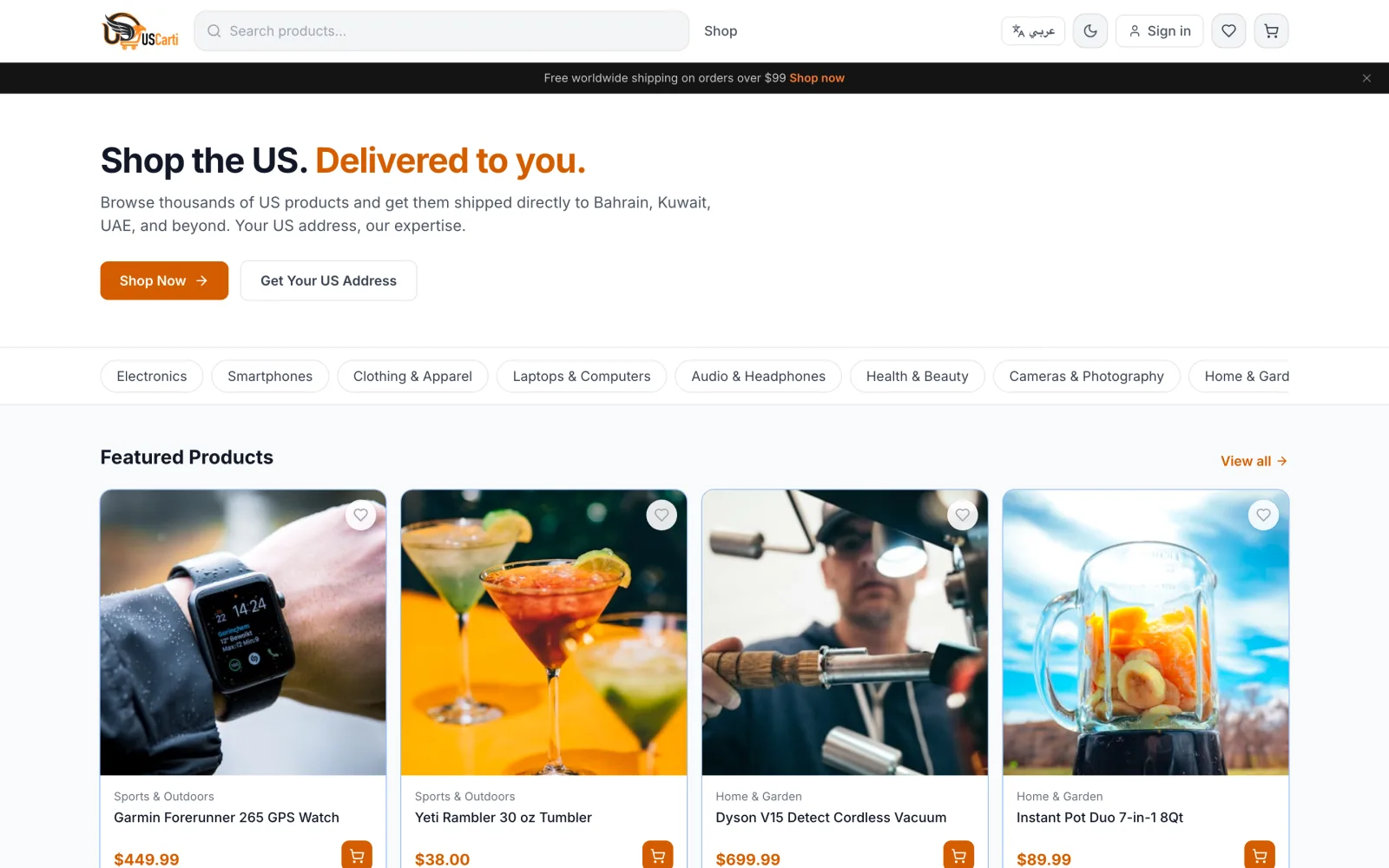
USCarti lets shoppers in the Gulf buy from US sellers and have their orders delivered through a forwarding service. We built the marketplace and its apps on the same backend that runs the forwarding warehouse, so an order and its shipment are one journey rather than two systems.
- Industry
- Cross-border e-commerce · marketplace
- Engagement
- Platform build: backend, storefront, apps, admin
- Platform
- .NET 10 modular monolith · React · Flutter
- Status
- Live at uscarti.com; payments in final testing
The business
Shoppers across the GCC want products from US stores, but buying them means juggling a foreign checkout, a forwarding address, and a separate shipment. USCarti puts both halves in one place: a marketplace to shop US products, backed by a forwarding service that receives, consolidates, and ships the orders abroad.
What we built
- A storefront in English and Arabic, with right-to-left layout, covering catalog, product pages, cart, checkout, orders, and a wishlist.
- Multi-vendor foundations: seller registration and verification, product reviews, and an affiliate program with commission tracking.
- Customer wallets that can be topped up by card or PayPal.
- Admin tools for the catalog, sellers, and carriers, alongside the forwarding operations.
- Flutter mobile apps for shoppers, forwarding customers, and admins.
One platform, two brands
The marketplace and the forwarding service share a single .NET 10 backend, organized as a modular monolith with eight modules: identity, customers, warehouse, shipping, billing, marketplace, notifications, and support. Each module owns its own database schema and its own rules.
Modules talk through domain events on RabbitMQ rather than calling into each other, and commands and queries are kept separate. When a marketplace order reaches the warehouse, it arrives already linked to the order that created it, so the customer sees one journey from checkout to delivery.
Two brands can share one platform when the boundaries inside it are real.
How it runs
The API runs on Azure App Service with SQL Server, and the web apps (storefront, customer portal, admin, and marketing site) are React and TypeScript on Azure Static Web Apps. Recurring background work runs as scheduled jobs. Live shipping integrations with Aramex and FedEx are in place, and the backend is covered by unit and integration tests.
The same foundations later became the base for eShip4ME, the forwarding brand's own standalone platform, which shares sign-in and customer accounts with USCarti.
Where it stands
The storefront and its companion sites are deployed at uscarti.com. Online payments are being finished in test mode, and growing the seller side of the marketplace is the next step.
Have a project like this?
We help teams architect, build, and ship software that keeps running. Let's talk about what you're building.
Start a conversation